
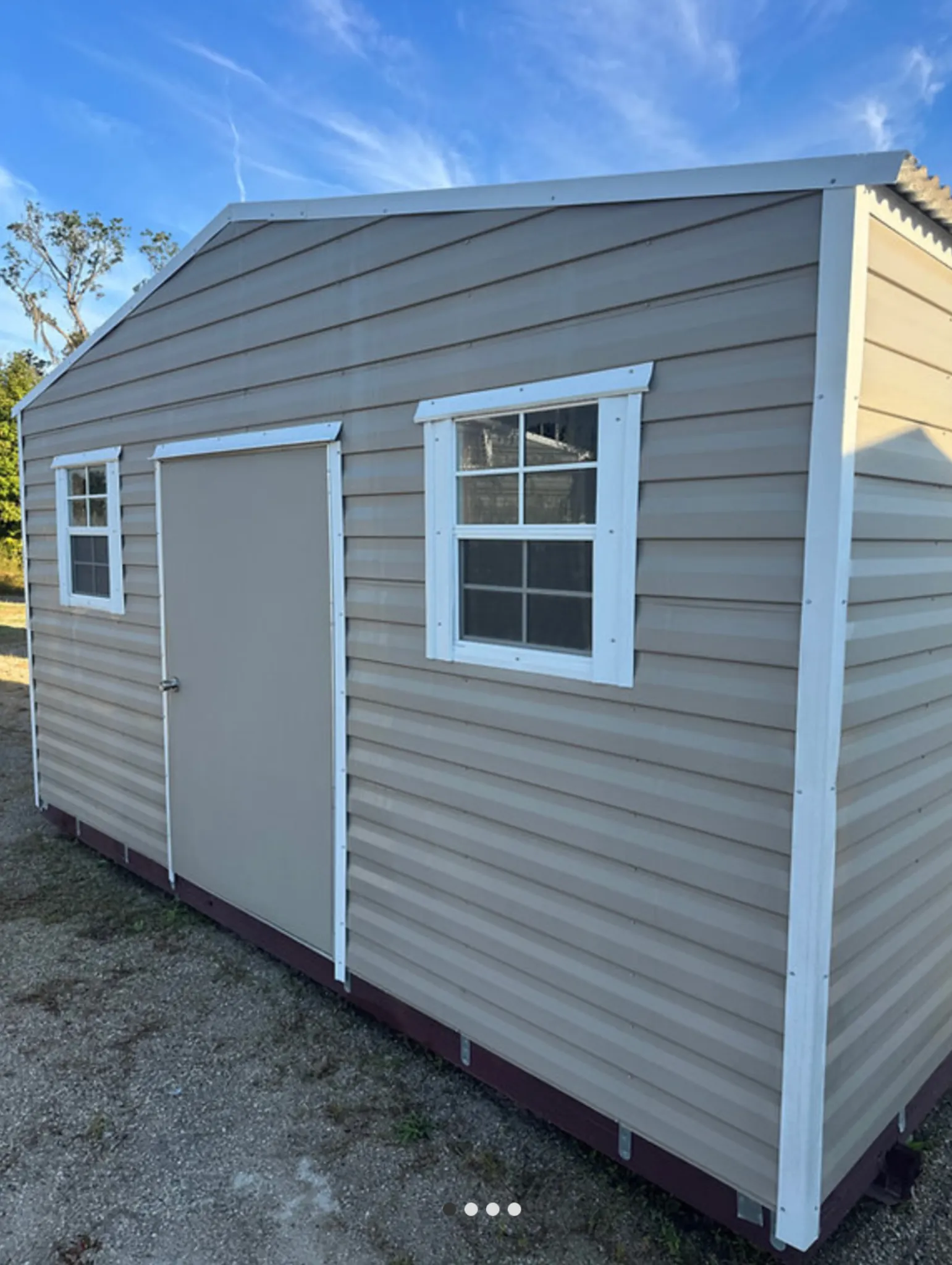
Almost everyone who buys a shed picks the size wrong on the first pass. The two failure modes are equally common: buying small because the price looks better, or buying large because bigger feels safer, without checking whether it can physically get into the yard.
This is the sizing conversation we have on the lot, written down.
Start with what goes in it, not with dimensions
Dimensions are abstract. Contents are not. Before you look at a single building, write down what is actually going inside.
The list usually includes some combination of: a mower, a wheelbarrow, ladders, lawn tools, bikes, pool equipment, holiday bins, paint and chemicals, a workbench, and whatever is currently making the garage unusable.
Then add the things you are not thinking of. Almost everyone underestimates seasonal storage and the amount of floor space a riding mower actually eats.
The sizing rule that matters
You need walking room, not just footprint. A shed packed wall to wall is a storage unit you have to unload to use. If the mower is in front of the tools, you move the mower every single time.
Plan on roughly a third of the floor being circulation if you want to actually use the building, and less if it is pure dead storage you access twice a year.
Rough guide by use
Small footprint, garden and lawn tools. Hand tools, a push mower, bags of soil, hoses, a few shelves. This is the classic garden shed and where our inventory starts, currently around $1,998 to $3,498 for garden shed models.
Mid footprint, the garage reclaim. A riding mower plus lawn equipment plus household overflow. This is the most common purchase we see. Storage and utility shed models currently run roughly $2,598 to $5,798.
Larger footprint, workshop or equipment. A workbench with room to stand and work, plus equipment storage. If you want the building to be a workspace rather than a storage box, this is the tier. The Lumberjack style is worth a look here because its barn-inspired roofline adds interior height and vertical space for taller equipment.
Lofted, when floor space is the constraint. Lofted Barn and Lofted Barn Porch styles put storage overhead and keep the floor clear. If you are storing seasonal bins that you touch twice a year, getting them off the floor changes what the building can do. Lofted barn models currently start around $4,898.
Multi-section, when it is a real workspace. Double Wide and Multi-Section units are for full workshops, equipment housing, and business storage. Same Accu-Steel framing system and the same wind-load ratings as the smaller buildings.
Current inventory across all styles runs from about $1,998 to $9,198. Pricing moves as stock turns, so check the inventory page for what is on the lot today.
The constraint most people forget: getting it into the yard
This is the single most common surprise on delivery day, and it has nothing to do with what fits in your budget.
We need roughly one foot of clearance on each side of the building to place it. In practice that means a 12-foot-wide gate generally allows for a 10-foot-wide building.
Before you decide on a width, go measure:
- Your gate opening, at the narrowest point
- The path from the street to the placement spot
- Overhead clearance, especially mature oaks and power service drops
- Any fence corner the building has to turn
- Slope, because a steep side yard changes what the delivery equipment can do
If the access is tight, tell us before you order. In some cases exceptions are possible depending on site conditions, and we would much rather look at it in advance than have a truck sitting in your street.
Height and roofline change the usable space
Two buildings with the same footprint can hold very different amounts.
- Lumberjack has a barn-inspired roofline that increases interior height and usable vertical space, good for riding mowers and taller equipment.
- Box Eave gives a modern roofline with efficient water runoff and a clean profile.
- Hip Roof slopes on all four sides, which improves structural stability and is worth considering on exposed lots.
- Lofted Barn adds a built-in loft above the main floor.
- Front Porch Cottage gives up some interior footprint for a covered porch, which is the right call if the building is a backyard retreat or home office rather than storage.
If you are stuck between two sizes, the roofline question often resolves it.
Do not forget the permit and the HOA
Size is frequently the exact thing that determines whether you need a permit. Requirements vary by city and county based on size, placement, and intended use, which means a building one foot smaller can land on the other side of a threshold.
Check before you buy. Our FAQ page links directly to the official permit pages for Jacksonville, Clay County, St. Johns County, Nassau County, Baker County, Putnam County, Flagler County, and Green Cove Springs.
HOAs commonly cap maximum length, width, and height, and also restrict color, door style, and placement. Confirm your neighborhood rules early in the process to avoid delays. We can customize buildings to help meet HOA requirements, but you will need to know what those requirements are.
The practical sequence
- List what goes in the building
- Add a third for circulation, or skip it if it is dead storage
- Measure your gate, path, and overhead clearance
- Check your county permit threshold and HOA limits
- Come stand inside two or three sizes at the lot before you commit
Step five is the one people skip and regret. Reading “8×12” means nothing. Standing in an 8×12 with a mental picture of your mower in the corner means everything.
Delivery timing
Once you have decided, in-stock buildings are typically delivered within 5 to 7 days. Custom-built buildings typically take 3 to 4 weeks. Delivery and installation are free within 50 miles, including leveling, anchoring, and tie-down.
We deliver across the metro, including Orange Park, Mandarin, St. Johns, and Fleming Island.
Frequently asked questions
What is the most common shed size people buy?
The mid-range building that holds a riding mower plus lawn equipment plus household overflow is the most common purchase. It is usually driven by wanting the garage back.
How much clearance do you need to deliver a shed?
At least one foot on each side of the structure. A 12-foot-wide gate generally allows a 10-foot-wide building. In some cases exceptions are possible depending on site conditions.
Should I buy bigger than I think I need?
Usually yes on interior volume, but only if the access allows it. A building you cannot get into the yard is not a bigger building, it is a cancelled order. Measure the gate first.
Does shed size affect whether I need a permit?
Often, yes. Permit requirements vary by city and county based on size, placement, and intended use, and size is frequently the deciding factor. Check with your local building department before ordering.
Can I add a loft later?
Lofted Barn and Lofted Barn Porch are designed with the loft built in. If overhead storage matters to you, choose that style up front rather than planning to modify later.
How much do sheds cost?
Current inventory runs from about $1,998 to $9,198 depending on size and style. Pricing changes as stock turns over, so check the inventory page for today’s list.
Come measure it in person
Bring your list and your gate measurement. We will walk you through the sizes, tell you honestly which one fits your property, and let you decide without pressure.
Visit the Philips Hwy Sales Lot at 9092 Philips Hwy in Jacksonville, browse the inventory, or ask about rent-to-own if you would rather spread the cost over up to 60 months.