
Every shed dealer in Florida quotes a wind rating. Very few explain what the number is attached to, and that gap is where people get burned after a storm.
Our Lark Accu-Steel buildings are rated for wind loads up to 160 mph. Here is what that actually means, what it depends on, and what to check on any building you are considering, ours or anyone else’s.
The rating is a condition, not a promise
A wind rating describes how a structure performs when it is installed and anchored the way the engineer specified. It is not a property of the building sitting on a sales lot.
That distinction matters more than anything else in this article. A 160 mph building that is set on uneven ground, not tied down, or anchored into the wrong substrate is not a 160 mph building anymore. It is a very well built box waiting to move.
This is why every building we deliver is leveled, anchored, and tied down according to the manufacturer’s installation requirements. It is not an upsell. It is the condition the rating depends on.
What fails first in a wind event
Sheds rarely fail in the middle of a wall panel. They fail at connections and at the ground.
Anchoring. The structure lifts or slides. This is the most common failure and the most preventable.
Fastener pull-through. Wind pressure works a fastener loose or pulls it through the panel. Screwed connections resist this better than nailed ones, which is one of the structural arguments for steel framing over wood.
Door and opening failure. A door blows in, the building pressurizes from the inside, and the roof goes. Openings are the weak point in almost any structure.
Debris impact. A rating is a wind load rating. It is not an impact rating. A branch traveling at speed is a different kind of problem.
Why steel framing helps here
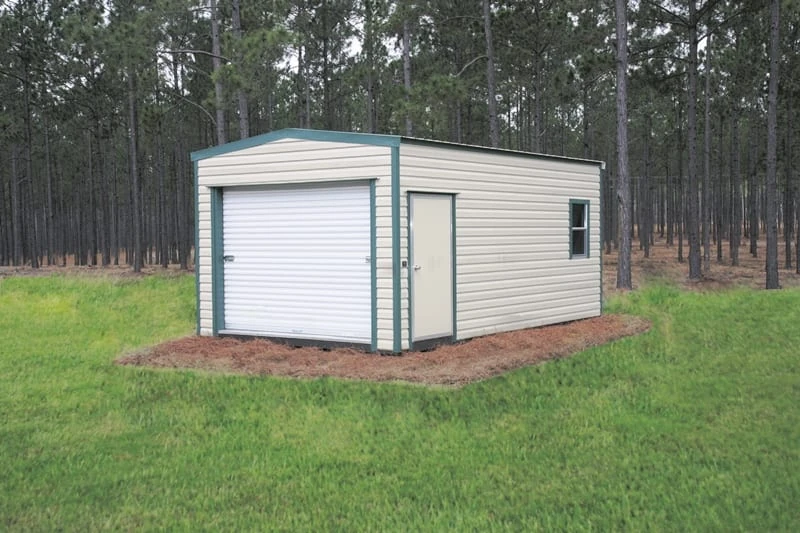
Lark Accu-Steel buildings use a fully integrated steel framing system with a steel roof frame, steel framed walls, reinforced cross bracing, and steel floor joists. There is no structural wood in the frame.
For wind specifically, a few things follow from that:
- Screwed connections instead of nailed. Steel framing has a lower probability of damage in high winds because the connections are mechanically fastened rather than driven.
- Dimensional stability. Steel does not expand, contract, or swell with moisture. A wood frame that has been through six Florida summers is not the same frame it was on day one. Connections loosen as the material moves.
- Nothing for rot or termites to weaken. A structure that is quietly losing strength to moisture or insects is not going to perform to its rating when it is tested.
Steel also has the highest strength-to-weight ratio of any common building material, which is the underlying reason the framing can be light and still carry the load.
What to ask before you buy any shed in Florida
- What is the rating, and under what installation conditions? If the answer is just a number with no conditions attached, that is a flag.
- Who anchors it, and is it included? Delivery and installation are free within 50 miles for us, and that includes leveling, anchoring, and tie-down. Confirm it either way with anyone you buy from.
- What substrate am I anchoring into? Sand, clay, a concrete pad, and pavers all behave differently. This is a site question, not a catalog question.
- What does the manufacturer warranty actually cover? Ours are published in full on the warranties page as manufacturer documents from Lark Accusteel and Metal Structures Company. Read the terms and exclusions rather than taking a summary from a salesperson.
- Does my county have wind-load requirements for accessory structures? Some do. Permit requirements vary by city and county based on size, placement, and use, and our FAQ page links to every local building department we serve.
Coastal properties are a different conversation
If you are on or near the water in Fernandina Beach, Amelia Island, Atlantic Beach, or Neptune Beach, you are dealing with higher design wind speeds and salt air on top of it.
Talk to your building department about the wind-load requirements for your specific address, and talk to us about anchoring for your specific soil. A generic answer is not useful on a coastal lot.
Before the next storm
A rating earned on delivery day does not maintain itself. Once a year, ideally before storm season:
- Check that anchors and tie-downs are still tight and have not shifted
- Check that the building is still level and has not settled on one corner
- Check door latches and hardware, since openings are the failure point
- Clear anything stored against the outside walls that could become debris
- Look at what is growing over the building, because limbs are the impact risk
Frequently asked questions
What wind rating do Lark Accu-Steel buildings carry?
They are rated for wind loads up to 160 mph when properly installed and anchored.
Does the rating still apply if I install it myself?
The rating depends on the building being installed and anchored to the manufacturer’s requirements. If it is not installed that way, the rating does not describe your building. Our delivery includes leveling, anchoring, and tie-down within 50 miles.
Is a wind rating the same as hurricane-proof?
No. A wind load rating describes performance under wind pressure. It does not address debris impact, storm surge, or flooding, and no accessory structure should be treated as a shelter.
Do I need a permit for a shed in a high-wind area?
Requirements vary by city and county based on size, placement, and use. Some areas have specific wind-load requirements for accessory structures. Check your local building department before delivery.
Does the warranty cover storm damage?
Warranty coverage is provided directly by the manufacturer and terms, conditions, and exclusions apply. Both manufacturer warranty documents are published in full on our warranties page. Read them rather than relying on a summary.
How often should I check the anchoring?
At least once a year, and after any significant storm.
Talk to us about your site
Anchoring is a site-specific question, and the honest answer depends on your soil, your lot, and your county. Come see buildings at the Philips Hwy Sales Lot at 9092 Philips Hwy in Jacksonville, or reach out to our team and tell us where the building is going.