
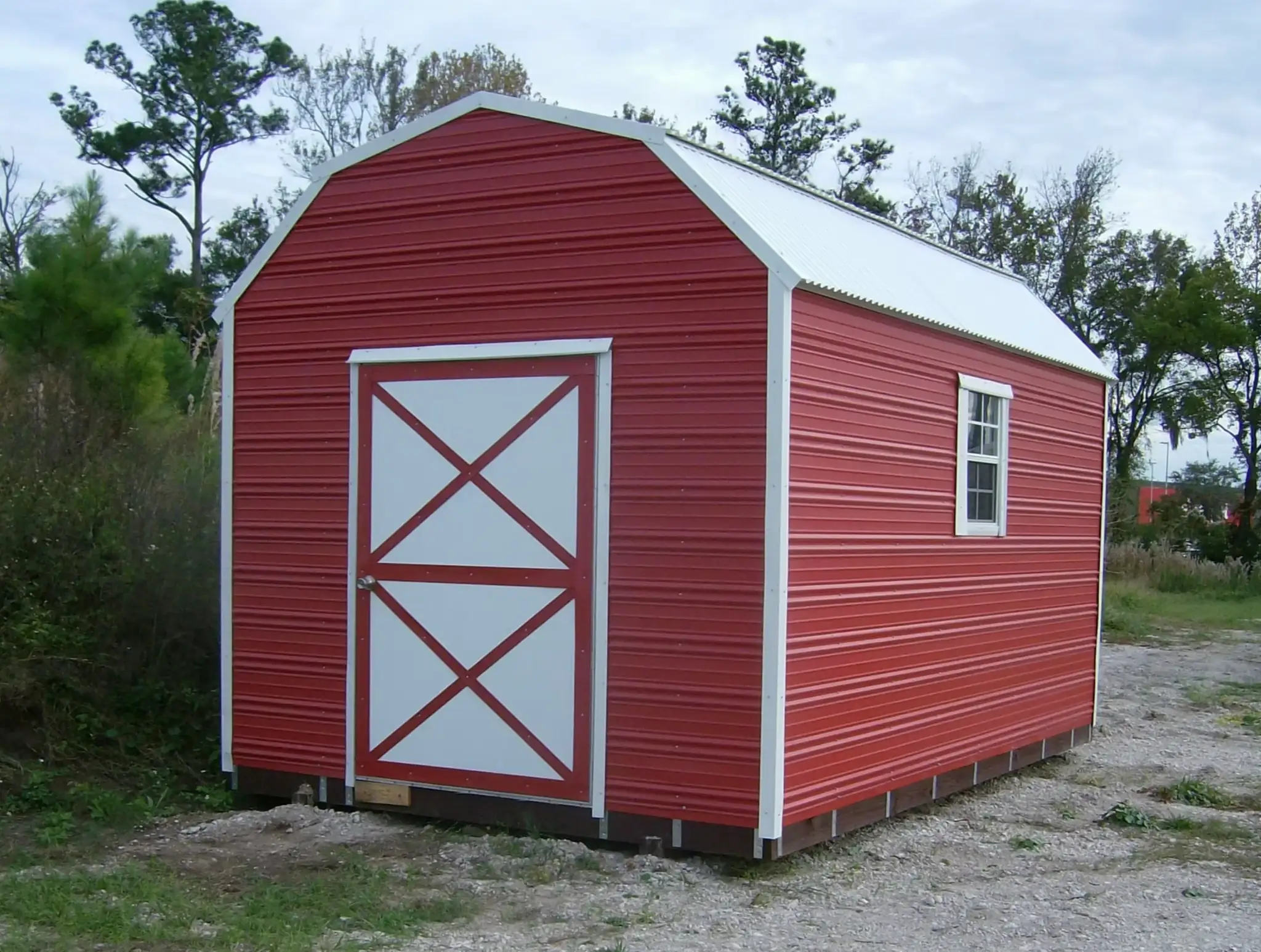
Atlantic hurricane season runs June 1 through November 30. By late October most of Northeast Florida has taken at least a few rounds of wind and heavy rain, and this is the right moment to look at your shed properly, while the weather is still a live concern and before the year gets away from you.
None of this takes long. Most of it is looking rather than fixing.
Start with the anchoring, because that is what fails
1. Check every anchor and tie-down
This is the most important item on the list. A wind rating describes how a building performs when it is properly installed and anchored. If the anchoring has shifted, loosened, or pulled, the rating no longer describes your building.
Look for anchors that have worked loose, straps with slack in them, and any anchor point where the ground around it has eroded or washed out. Sandy soil in particular moves after heavy rain.
2. Check that the building is still level
Sight down the base and along the roofline. A corner that has settled puts the whole structure out of square, which stresses connections and stops doors from closing properly. Settling after a wet season is common, especially on fill or sand.
3. Look at the ground around the base
Erosion, pooling, and washout at the base are early warnings. Water that sits against a building is a problem all year, not just in a storm.
Then the shell
4. Doors and latches
Openings are where structures fail in wind. A door that blows in pressurizes the building from the inside and the roof takes the load. Check that latches engage fully, hinges are tight, and the door still sits square in the frame.
5. Fasteners
Walk the panels and look for fasteners that have backed out or worked loose. Screwed connections resist wind well, but any fastener that has loosened is no longer doing its job.
6. Roof and panel seams
Look for lifted edges, separated seams, and any panel that has taken a debris hit. A small lifted edge in October becomes a much larger problem by next August.
7. Signs of water intrusion
Check the interior ceiling and the top of the walls after a heavy rain. Stains and streaks tell you where water is getting in even if you have never caught it in the act.
Then the inside
8. Moisture and airflow
Florida humidity does not take the winter off. Check for condensation, musty smell, and corrosion on anything metal you are storing. If the building is sealed tight and holding damp air, ventilation is the fix.
9. What you are storing against the walls
Anything stacked against an exterior wall from the inside blocks your ability to see problems, and anything leaning against the outside is potential debris. Move it.
10. Fuel and chemicals
Mower fuel, generator fuel, pool chemicals, paint. Check containers for degradation and make sure nothing has been sitting in a way you would not want it to sit through another storm. This is a routine safety check, not a storm-specific one, but the end of the season is a good prompt.
Then the surroundings
11. Overhanging limbs
A wind load rating is not an impact rating. A branch traveling at speed is a different category of problem. Look up. Anything hanging over the building that you have been meaning to deal with is exactly the thing that comes down in the next storm.
12. Drainage paths
Watch where water goes during the next heavy rain. If runoff from the roof of your house or a slope in the yard is directing water at the shed base, that is a fixable problem and it is quietly working on your anchoring.
What to do if you find something
Anchoring problems: address them now rather than in June. This is the item worth acting on immediately.
Structural damage: warranty coverage is provided directly by the manufacturer and terms, conditions, and exclusions apply. Both manufacturer warranty documents, from Lark Accusteel and Metal Structures Company, are published in full on our warranties page. Read them rather than relying on a summary.
A building that is past saving: it happens, usually with older wood-framed structures that have been quietly losing strength to moisture and termites for years. If that is where you are, talk to our team. Our Lark Accu-Steel buildings use a fully integrated steel framing system with no structural wood, rated for wind loads up to 160 mph when properly installed and anchored, and every building we deliver is leveled, anchored, and tied down to the manufacturer’s requirements.
A note on coastal properties
If you are in Atlantic Beach, Neptune Beach, Fernandina Beach, or Amelia Island, add salt air to the list. Check metal hardware, hinges, and fasteners more carefully, and do this inspection twice a year rather than once.
Frequently asked questions
When does hurricane season end in Florida?
Atlantic hurricane season runs from June 1 through November 30.
How often should I check my shed anchoring?
At least once a year, and after any significant storm. The end of hurricane season is a natural annual checkpoint.
My shed shifted slightly during a storm. Is that a problem?
Yes, treat it as one. Movement means the anchoring is no longer doing what it was installed to do, and the wind rating depends on that anchoring. Have it looked at before the next season.
Does the manufacturer warranty cover storm damage?
Coverage is provided directly by the manufacturer and terms, conditions, and exclusions apply. The full warranty documents are published on our warranties page.
Can you re-anchor an existing building?
Talk to our team about your situation. Every building we deliver is leveled, anchored, and tied down as part of free installation within 50 miles.
What is the most common shed failure in a storm?
Anchoring, followed by doors. Buildings usually fail at the ground connection or at an opening, not in the middle of a panel.
If it is time to replace it
If this inspection turned up a building that is not going to make it through another season, come look at the alternatives. Visit the Philips Hwy Sales Lot at 9092 Philips Hwy in Jacksonville, browse the inventory, or ask about rent-to-own with one month down and no credit check.