
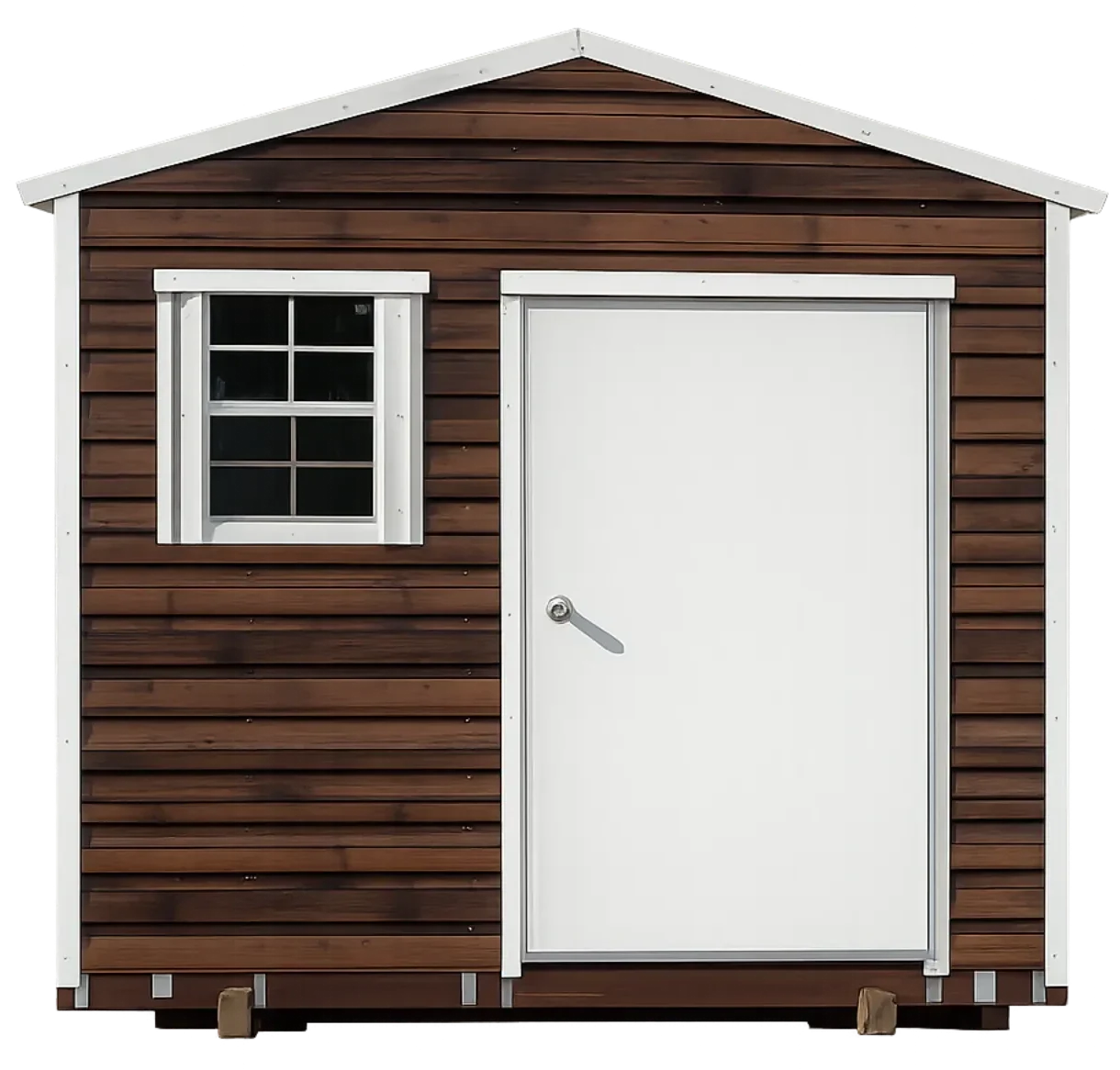
A lot of our customers arrive having paid for a storage unit for years. They do the math once, realize what they have spent, and start looking at buildings.
That math is worth doing deliberately rather than emotionally, because a storage unit is genuinely the better answer in some situations. Here is how to run it honestly.
The core difference
A storage unit is a recurring expense that never ends and never builds anything. A shed is a purchase that ends, after which the storage is free.
The crossover point is where total rent paid exceeds the cost of the building. Past that point the unit is pure loss and the shed is pure gain.
That is the simple version. The real comparison has more moving parts.
How to run the numbers for your own situation
Step 1: Find your actual monthly unit cost. Not the promotional rate you signed at. What you are paying now, including any insurance or admin fee on the bill.
Step 2: Multiply by 12, then by the number of years you realistically expect to keep needing storage. Be honest here. Most people who say “just another year” have been saying it for three.
Step 3: Compare against the building cost. Our current inventory runs from about $1,998 for a compact garden shed to around $9,198 for a lapsider cottage, with mid-size storage and utility sheds currently in the range of roughly $2,598 to $5,798. Pricing moves as stock turns, so check the inventory page for today’s list.
Step 4: Add the factors below to both sides. This is where most comparisons go wrong.
What people leave out of the shed side
- Site prep. If your ground needs leveling or a pad, that is a real cost.
- Permits. Requirements vary by city and county based on size, placement, and use. Some situations require one, some do not.
- The space it occupies in your yard. If your lot is small, giving up that footprint is a genuine cost even though it does not appear on an invoice.
- HOA constraints. If your neighborhood restricts what you can put up, that may limit your options or rule it out entirely.
What is not a hidden cost on our side: delivery and installation are free within 50 miles, including leveling, anchoring, and tie-down. Electrical pre-wiring is included.
What people leave out of the unit side
- Rate increases. Storage rates are not fixed. The rate you sign at is rarely the rate you pay in year three.
- Drive time. Every trip to the unit is time. If it is 20 minutes each way and you go twice a month, that is real.
- Access friction. This is the underrated one. Things in a storage unit stop getting used. People pay for years to store items they would not pay to replace, because retrieving them is annoying enough that they never do.
- Insurance. Often required and often a separate line.
Where a storage unit genuinely wins
Climate control. If you are storing anything that truly needs temperature and humidity control, a conditioned unit does something a backyard building does not do out of the box.
Short-term needs. Between houses, a deployment, a renovation. If the need has an end date within a year or so, renting is usually correct.
No yard, or a yard you cannot build in. Apartment, condo, restrictive HOA, small lot with setbacks that do not leave a legal spot. The comparison is moot if you cannot put a building anywhere.
Storing a vehicle or boat you cannot keep at home. Some neighborhoods do not allow it at all.
Where the shed wins
Long or open-ended need. If there is no end date, you are on a subscription with no exit.
Frequent access. Tools, lawn equipment, sports gear, anything you use rather than store. The friction difference is enormous. A shed twenty feet from your back door gets used. A unit across town does not.
Reclaiming the garage. This is the actual motivation for most of our customers. The stuff is not really in storage, it is in the garage, and the garage is not usable. A shed moves it out and gives you back a room.
You would rather own than rent. Straightforward enough.
The financing angle
If the obstacle is having the full amount up front, that is what rent-to-own is for. One month down, no credit check required, terms up to 60 months, and you can pay the balance off early at any time.
Structurally, that turns the comparison into monthly payment versus monthly rent, except one of them ends with you owning a building and the other one never ends.
Practical considerations before you decide
Check access. We need roughly one foot of clearance on each side of the building to place it. A 12-foot-wide gate generally allows a 10-foot-wide building. Measure your gate before you get attached to a size.
Check the permit. Our FAQ page links to the official building department pages for every county we serve.
Check the HOA. Colors, maximum dimensions, door style, and placement rules are all common restrictions.
Think about ventilation. Florida humidity is hard on stored goods. Plan for airflow if you are storing anything that cares.
Delivery across the metro
Free delivery and installation within 50 miles reaches most of the Jacksonville area, including the Southside, Westside, Arlington, and Orange Park. In-stock buildings typically arrive within 5 to 7 days.
Frequently asked questions
Is a shed cheaper than a storage unit long term?
It depends on your unit rate and how long you need storage. A shed is a one-time cost and a unit is recurring, so there is a crossover point. Run your own monthly rate against current building prices to find yours.
How long until a shed pays for itself?
That is entirely a function of your storage unit rate and the building you buy. Take your current monthly rate, multiply by twelve, and compare to the building price to get the number of years.
Can I get a shed if I do not have the full amount up front?
Yes. Rent-to-own requires one month down with no credit check, terms up to 60 months, and early payoff at any time.
Do sheds have climate control?
Our buildings include electrical pre-wiring, which means they are ready for an electrician to connect. Conditioning the space is separate work. If you need true climate control for what you are storing, factor that in.
Do I need a permit to put a shed in my backyard?
Requirements vary by city and county based on size, placement, and intended use. Check your local building department before ordering.
What if my HOA does not allow sheds?
Confirm the specifics, because many HOAs restrict rather than prohibit. Common rules cover color, maximum dimensions, door style, and placement. We can customize buildings to help meet HOA requirements once you know what they are.
Run your numbers with us
Bring your monthly storage rate and what you are storing. We will show you buildings that actually fit it and tell you honestly whether the move makes sense for you.
Visit the Philips Hwy Sales Lot at 9092 Philips Hwy in Jacksonville or browse the inventory.